RS-140
MIDI to CV converter
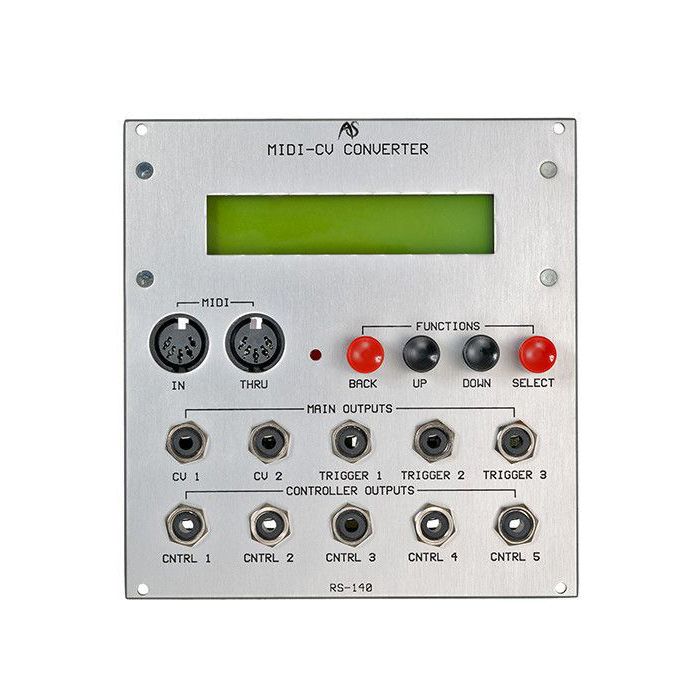
Midi/CV Converter. 2X20 display. 5 controller outputs, individually defined. 3 trigger outputs individually defined, trigger, gate, S trigger or midi clock. 1 CV out (On 2 sockets) 64 memories selectable as patches over midi.
Besides the usual CV and gate outputs in addition it offers flexible controller outputs and its big backlit display and four function buttons make it easy to use. In the CV menu you can set the voltage characteristic of the CV outputs (either 1V/octave or 1.02V/oct as the Minimoog had), the note range of the pitchbend wheel and the modulation depth of the internal LFO. This LFO can be synchronized to MIDI Clock, has several wave forms and MIDI-controlled level. Both CV outputs carry the same signal and they are active buffered.
Each trigger socket can output a gate, a trigger or a S-trigger (for old Moogs), either as multi trigger or single trigger. Alternatively you can output the MIDI clock thats rate can be divided down in 9 settings.
Controller: each controller output can be assigned to one of 128 Control Change commands, the pitch bend wheel, velocity or aftertouch (plus the internal LFO for controller output 1). Besides that you can set one of four output voltage ranges (0 bis 5V; -5V bis 0V; -2,5V bis 2,5V und -5V bis 5V).
All settings can be saved in the non-volatile memory and you have 64 memory slots. Each of them can be recalled by Control Change messages.
Особенности устройства с сайта производителя
PORTAMENTO
The pitch CV produced by CV1 and CV2will respond to MIDI Portamento commands, as follows:
- Portamento On/Off - The RS140 responds to MIDI CC#65 - PortamentoOn/Off. Values in the range 0 to 127 are accepted. For received values in the range 0 to 63, portamento is Off. For received values in the range 64 to 127, portamento is On.
- Portamento Rate - The RS140 responds toMIDI CC#5 - Portamento Time MSB. Values in the range0 (off) to 127 are accepted. MIDI CC#37 (Portamento Time LSB) is ignored.
INPUTS AND OUTPUTS
The RS140 offers twelve connection sockets, of which two carry MIDI signals, and ten carry analogue signals.
MIDI Connections
- • MIDI IN Connect the output (MIDI OUT) from another MIDI device to the MIDI IN of the RS140.
- • MIDI THRU Any MIDI data received at the MIDI IN of the RS140will be echoed (transmitted) by the MIDI THRU socket. This allows you to use the RS140 within a daisy-chain of MIDI devices.
Note: The RS140 generates no MIDI data of its own.
Analogue Connections
All analogue connections are outputs, as follows:
• CV1, CV2 These outputs carry pitch CVs derived from MIDI note data.The RS140 responds to the standard MIDI note range, with an output of 0V produced by MIDI note #24.
• TRIGGER1, TRIGGER2, TRIGGER3 These outputs carry Triggers and Gates derived from the MIDI data.
• CNTRL1, CNTRL2, CNTRL3, CNTRL4, CNTRL5 These outputs carry up to five CVs that the RS140 derives from MIDI controller data.
MIDI DETECT LED
The red LED on the RS140's front panel will flash when the module detects a MIDI signal transmitted on the selected channel.



 Купить Analogue Systems RS-140 MIDI/CV Converter - лучшая цена с доставкой по России в mustore.ru
  Купить Analogue Systems RS-140 MIDI/CV Converter - лучшая цена с доставкой по России в mustore.ru
  Купить Analogue Systems RS-140 MIDI/CV Converter - лучшая цена с доставкой по России в mustore.ru